Choice
Select one label from a list: tool, model, route, browser action, or escalation path.
route: "human_review"A practical guide to bounded decisions, typed outputs, and the code that turns a judgment into an action.
Jev is a decision model accessed over TypeSafe's network API. Your program sends text or structured state and defines the answers Jev is allowed to return. Jev responds with a choice, a score, or a yes/no probability instead of free-form prose.
That narrow job matters. Many agent loops repeatedly ask small questions: which tool should run, whether a browser task is complete, how risky a patch looks, or which queue should receive a ticket. A general language model can answer those questions, but it also brings open-ended generation, slower calls, and output parsing to a job that may only need a branch.
Typed output does not make every answer correct. It keeps the answer inside the structure your code expects, while probabilities give policy a place to handle uncertainty.
Select one label from a list: tool, model, route, browser action, or escalation path.
route: "human_review"Rate urgency, quality, risk, relevance, or completion on an ordered scale.
risk: 3.2 / 4Return a yes/no probability so code can allow, block, or ask a human.
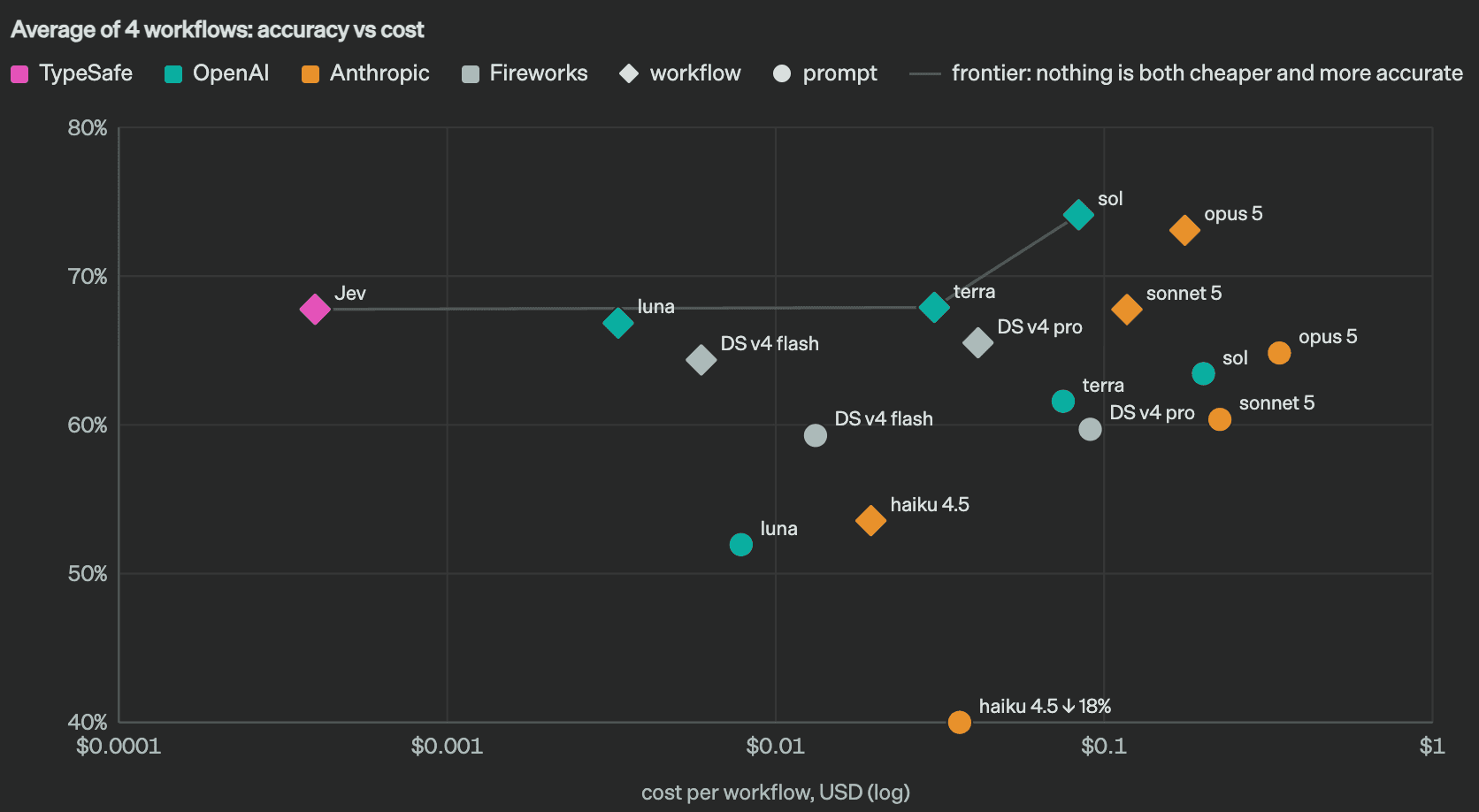
goal_met: 0.93TypeSafe publishes a 70–500 ms response range and a launch price of $0.042 per million input tokens, with output described as free. Those are vendor figures. Real agent latency also includes state construction, network distance, tools, retries, and the rest of the loop.
No. Jev is a hosted decision model. It can choose, score, or return a yes/no probability from bounded options. Codex, Claude Code, browser tools, and ordinary programs still generate content and perform actions.
Jev runs on TypeSafe's servers and is called over an API. The Python SDK and official Agent Skill help your local code or coding agent build that integration; they do not install the Jev model on your computer.
Use the TypeSafe Playground without installing anything. Give it a state, add a Choice, Score, or Noul question, and inspect the returned answer and probabilities before deciding whether the task belongs in an agent workflow.
No. The 70–500 ms range and $0.042 per million input tokens are TypeSafe's launch figures. Community project metrics are labeled as reported by their authors. JevForAgents does not present either as a first-hand test.
The supplied clip shows a resume beside an application form. A safe Jev workflow would first extract candidate facts, ask Jev which candidate best matches each field, and let browser code fill only the confirmed values. Sensitive or missing answers stay blank, and the user controls final submission.
Jev’s proposed role is semantic matching. Reading the PDF, pasting values, answering sensitive questions, and submitting the application remain outside that role. The original publication URL is still needed to verify that this recording actually uses Jev.
Explore video demos →