THE PRACTICAL DATABASE & DIRECTORY

Jev for Agents: How Jev Powers Real AI Agents

Browser agents, coding agents, routers, tool selection, evaluation and guardrails — with real builds, demos and implementation patterns.

405Curated Builds
198Visual Demos
9Core Patterns
100%Evidence Sourced

Independent curation. Sources and evidence on every example.

38,000,000+ VIEWS ON 𝕏
Diogo Almeida
Diogo Almeida@CompleteSkeptic · Sep 15

After co-inventing ChatGPT, I kept asking myself: why have superhuman chat models not led to AGI?

I spent the last 2 years building a new way to train models (RLCD) and a new type of frontier AI model we are releasing today: Jev

  • 20–200× faster than conventional generative models
  • 40–400× cheaper (with output tokens free)
  • Composable intelligence optimized for agent decisions
💬 3.9K🔁 8.2K❤️ 74.5K📊 38.4M Views
WHAT THIS REPRESENTSJev makes the bounded decision. Code, tools, and agents execute.

Real Jev AI agent builds and demos

Showing 40 builds matching criteria
a16z
a16z@a16z · 2026-09-28
Case summary

In an a16z interview, TypeSafe AI’s Diogo Almeida joins Ben Horowitz and Martin Casado to discuss Jev, automation and reliability. The central idea is to give software typed choices with confidence signals so code can handle intent and uncertainty. This is a product and architecture discussion, not a runnable project.

🤖 Jev AgentFounder interview

Jev in Software: A TypeSafe Founder Interview

WHAT JEV DECIDES

Explains typed choices and confidence as decision inputs for application code.

elune
elune@elune0x · 2026-09-24

Jev just made the Claude Code vs Codex debate obsolete I connected both to Jev - now the best coding agent is selected for every task, and neither can cross a risky tool boundary without a typed decision in one run it scanned 247 files, routed the security audit to Claude Code, routed the patch to Codex, passed 18/18 tests and stopped npm publish before execution here’s how to set it up in 10 min: task → Jev decision → Claude Code / Codex → tool execution → fresh verification step 1 → open @typesafeai and create your Jev API key (never paste it into chat) step 2 → clone and verify the complete agent switch step 3 → export the key before starting either agent: export TYPESAFE_API_KEY="YOUR_KEY" step 4 → test the full decision layer before connecting a live agent: npm run doctor && npm run check:claude && npm run check:codex step 5 → connect Claude Code directly from the repository: claude --plugin-dir . Claude discovers the plugin and turns Jev review decisions into real confirmation requests step 6 → for Codex, install the same folder through your local plugin marketplace, open /hooks and trust the exact PreToolUse hook Codex uses the same policy and safely stops calls that need human review step 7 → keep agent: auto and the plugin detects Claude Code or Codex automatically - or set agent: claude / codex when you want to lock one runtime step 8 → start in shadow mode for 20–50 real decisions: export JEV_AGENT_SWITCH_MODE="shadow" && export JEV_AGENT_SWITCH_LOGGING="true" your agent keeps working normally while Jev records the route, confidence and outcome without blocking anything step 9 → switch to enforce only after the decisions look reliable: export JEV_AGENT_SWITCH_MODE="enforce" safe calls pass, uncertain calls stop for review, dangerous calls are denied the default boundary is 0.62 minimum confidence and 0.86 harmful-action probability step 10 → use it normally - ask Claude Code or Codex to inspect, patch, test or prepare a release; the same Jev layer stays in front of both the result: Claude Code handles deep repository context, Codex handles fast patches and verification, and Jev decides which worker gets the task - while keeping publishing, production and irreversible actions behind a human boundary unfortunately, most people are still comparing coding models as if one model needs to win forever the actual 2030 setup makes the model replaceable: one task enters, Jev selects the best worker, code enforces the decision and every action leaves a receipt Steal the agent setup everyone will use by 2028, copy the repo below - then read the full Jev Engineering playbook ↓

🤖 Jev AgentCODING AGENTS

Elune Coding Agent Switch

WHAT JEV DECIDES

Select Claude Code or Codex and review tool calls before execution.

Miles
Miles@miles_matthias · 2026-09-21

I turned hermes into my iMessage router and bridge to codex. I have multiple codex projects going on, each with multiple tasks, so jev providing quick cheap context finding when I text Hermes something random is amazing

🤖 Jev AgentJev AssistantCODING AGENTS

Hermes iMessage Bridge to Codex

WHAT JEV DECIDES

Find relevant context; the precise bounded output is not disclosed.

Brad Wardell
Brad Wardell@draginol · 2026-09-21

Mac Version of Clairvoyance now has Jev support if you have Plus or higher. If you have Claude Code, Codex, OpenRouter, Grok Build, or Cursor you can save literally millions of tokens. When enabled, Clairvoyance will automatically try to use Jev when decision making on files. Also integrated into Deep Search and Code Search. Does require Plus or higher but here's an invite for you for the Mac version. https://t.co/Ck6RjplYOf

🤖 Jev AgentCODING AGENTS

Clairvoyance Jev Integration for Mac

WHAT JEV DECIDES

Make file-related decisions within Clairvoyance; exact outputs are undisclosed.

Gavin
Gavin@Frozune · 2026-09-19

I cannot use codex the same anymore after installing a jev-based autorouter https://t.co/7ABawReZMJ the model and effort change based on the complexity of the task and its near instant and almost free https://t.co/vLIfHdR4vN

🤖 Jev AgentAGENT ROUTING

Gavin's Jev Codex Model and Effort Router

WHAT JEV DECIDES

Choose the Codex model and reasoning effort for a task.

Vlad Terin
Vlad Terin@VladTerin · 2026-09-17

I talk. Codex clicks. Watch the browser go⚡ This video is 1× !!! speed. Built Jev Browser: an open-source adapter for your existing Codex browser tools. Say the task naturally; Codex plans, Jev selects, the browser moves. @sama @OpenAI make this native? @DarioAmodei @hackgoofer https://t.co/xzvUPFBbGa

🤖 Jev AgentBROWSER AGENTS

Vlad Terin Jev Browser

WHAT JEV DECIDES

Choose the next browser action; the exact input schema is not disclosed.

Lahfir
Lahfir@mdlahfir · 2026-09-16

Jev solved local harness/model routing I use a combination of Claude Code, Codex and Opencode as my local agentic stack and routing to other harnesses was always enforced in the system prompt/rules With a deterministic hook that Claude Code can decide before delegation, Jev helps to route to the right harness/model based on the task, and it's pretty accurate based on the intensity/intelligence of the task > Mechanical tasks get routed to Haiku > Intelligent ones to Opus sub-agents > Long-running implementation work to external harness

🤖 Jev AgentAGENT ROUTING

Lahfir Local Harness Router

WHAT JEV DECIDES

Select a local coding harness or model tier before delegation.

Instructa
Instructa@instructa · 2026-09-18

Experimental. I currently recommend against adopting this routing workflow. I built Switchloom to see whether mixing models could get me the same quality for less money. My benchmarks did not deliver that result. In the second Pokédex run, the team with Jev cost almost as much as Astra alone and hit the time limit before final acceptance. Astra finished and passed all 14 independent functional checks.

🤖 Jev Agent⚡ Jev SkillsAgent Routing

Switchloom

WHAT JEV DECIDES

Optional Jev route to model/capability slot; Codex executes the tasks.

jackbarunz
jackbarunz@jackbarunz · 2026-09-21

Jev-powered MCP tool routing for Codex. Instead of exposing hundreds of external MCP tool schemas directly to the agent, Jev Tool Router exposes a small routing surface and resolves external tool discovery on demand.

⚡ Jev SkillsTool Selection

Jev Tool Router

WHAT JEV DECIDES

Picks the specific MCP tool for Codex to prevent tool context overflow.

Kai
Kai@hqmank · 2026-09-20

Combined Jev with Playwright-controlled Chrome to build jev-browser, a general browser automation skill. Works across agents. Two demos in Antigravity CLI and Codex: finding related articles, then job openings on a site. Both ran fast. This could handle many more browser tasks.

🤖 Jev Agent⚡ Jev SkillsBrowser Agents

Jev Browser Skill (jb)

WHAT JEV DECIDES

Choose the next in-page browser action for a bounded task.

Engine
Playwright
Demos
2 author demos
rody
rody@0x_rody · 2026-09-21

Jev has been blowing up lately. If you've got the Jev API but don't know how to play around with it yet, you can just copy this checklist. 1. jev-ultrafast A high-speed browser Agent built with Browser Use. Jev only judges "what to do, which element to click" at each step, and only calls the small model when typing is needed. Searching for a flight on Google Flights takes about 7 seconds. https://github.com/browser-use/jev-ultrafast 2. fast-jev-compaction Context compression for Claude Code. Before each tool call, have Jev judge if there's anything still useful; delete the useless stuff, and keep the original text without rewriting it. https://github.com/tamaratran/fast-jev-compaction 3. json-render Vercel Labs' generative UI framework. In experiments, Jev doesn't write JSON token by token; it just handles selecting components, properties, and layouts. https://github.com/vercel-labs/json-render 4. typesafe-mcp Best for people who just got the API. Plug Jev into Claude Code, Claude Desktop, Codex, and Pi, and do Choice / Score / Noul anytime. https://github.com/itsmostafa/typesafe-mcp 5. jev-mcp Ready-made Agent judgment toolkit: fact-checking, content screening, semantic ranking, classification, and information extraction. https://github.com/jkudish/jev-mcp 6. SemDecide Turn Jev into a command-line tool. Directly classify, score, and filter in the Shell—great for hooking up to crawlers, CI, and data pipelines. https://github.com/sharziki/semdecide 7. jev-codex-router First have Jev judge how hard this round of programming tasks is, then decide the model tier, reasoning depth, and speed mode. https://github.com/0xNatoshi/jev-codex-router 8. Winnow Context garbage collection for Claude Code. When Read / Bash / Grep spits out a ton of stuff, Jev first judges which parts are really relevant to the current task. https://github.com/GhalebDweikat/winnow 9. jev-review Before code review, run it through Jev first to pick out high-risk changes, then hand them off to a pricier big model or a human. Comes with a local dashboard. https://github.com/devagrawal09/jev-review 10. Blink Use Jev as a code repository navigator. At each directory level, judge which files are most relevant to the current issue, then keep digging down. https://github.com/ellipsis-dev/blink Copy these complete Jev blueprints - then read full Jev setup below ↓ ↓

🤖 Jev AgentJEV AGENT

0x_rody Jev Agent Workflow

WHAT JEV DECIDES

DOM Action Selection

Views
185.3k
Likes
1.2k
Category
Jev Agent
Muhammad Ayan
Muhammad Ayan@socialwithaayan · 2026-09-21

10 Jev Repos Blowing Up Right Now (and What They Actually Do) 1. jev-ultrafast 15k stars Browser Use agent. Jev picks the next click. A small model only types when needed. https://github.com/browser-use/jev-ultrafast 2. fast-jev-compaction 5.8k stars Claude Code context trim. Jev scores tool calls, drops junk, keeps useful text verbatim. https://github.com/tamaratran/fast-jev-compaction 3. jev-trader 1.7k stars Monad market maker. One Jev buy/sell decision every block. About 81ms latency. https://github.com/jarrodwatts/jev-trader 4. skills (TypeSafe) 1.5k stars Official agent skill for Claude Code and Codex. Choice, Score, Noul patterns included. https://github.com/typesafe-ai/skills 5. agent-desktop 1.4k stars Desktop automation on the accessibility tree. Jev picks the next button or input. https://github.com/lahfir/agent-desktop 6. typesafe-computer-use 719 stars macOS computer use for about $0.0002 a step. OCR the screen, Jev chooses the action, click. https://github.com/awlevin/typesafe-computer-use 7. jev-review 457 stars Staged code review with a local dashboard. Jev flags risk before you burn a frontier model. https://github.com/devagrawal09/jev-review 8. foreman 454 stars Agent supervisor. Jev decisions keep coding agents on task inside a software factory loop. https://github.com/thruwire/foreman 9. hermes-jev-skills 360 stars Jev routing, memory, compaction, skill pick, and computer use for Hermes, Claude Code, and Codex. https://github.com/kerpopule/hermes-jev-skills 10. pg-jev 272 stars Postgres extension. Ask your tables questions in plain English with WHERE jev(...). https://github.com/realZachi/pg-jev

⚡ Jev SkillsJEV SKILLS

Social with Aayan Jev Skills Workflow

WHAT JEV DECIDES

Dynamic Skill Selection & Tool Routing

Views
98.1k
Likes
553
Category
Jev Skills
Showing 12 of 40
SECTION 03 / SYSTEM ARCHITECTURE

What is Jev AI?

Jev is an AI model built by TypeSafe AI for fast, structured decisions inside software and AI agents. Unlike a conventional large language model that generates text token by token, Jev takes application state as input and returns typed decisions, probabilities and confidence that code can use directly.

Jev is TypeSafe AI's first System One Model

TypeSafe describes Jev as its first public System One Model: a model optimized for automation tasks such as classification, routing, scoring, verification and choosing between a predefined set of actions. (TypeSafe AI)

That makes Jev especially interesting for AI agents. An LLM can handle planning, reasoning and generation, while Jev handles the repeated decisions inside the loop:

observe→decide→act→verify→continue

The builds above show this pattern in practice across browser agents, coding agents, model routers, tool selection, computer use and agent guardrails.

For a closer look at a proposed coding-agent harness, read the Jev Engineering for Coding Agents PDF guide. It separates the independent PDF's design ideas from official Jev documentation and measured results.

Is Jev an LLM?

Not in the conventional sense.

Traditional LLMs are optimized to generate strings: explanations, code, chat responses and other sequences of tokens. Jev gives up general string generation and instead produces type-safe structured values with probabilities and confidence scores.

TypeSafe summarizes the distinction as unstructured state going in and typed probabilistic decisions coming out. (TypeSafe AI)

A simple way to think about the difference is:

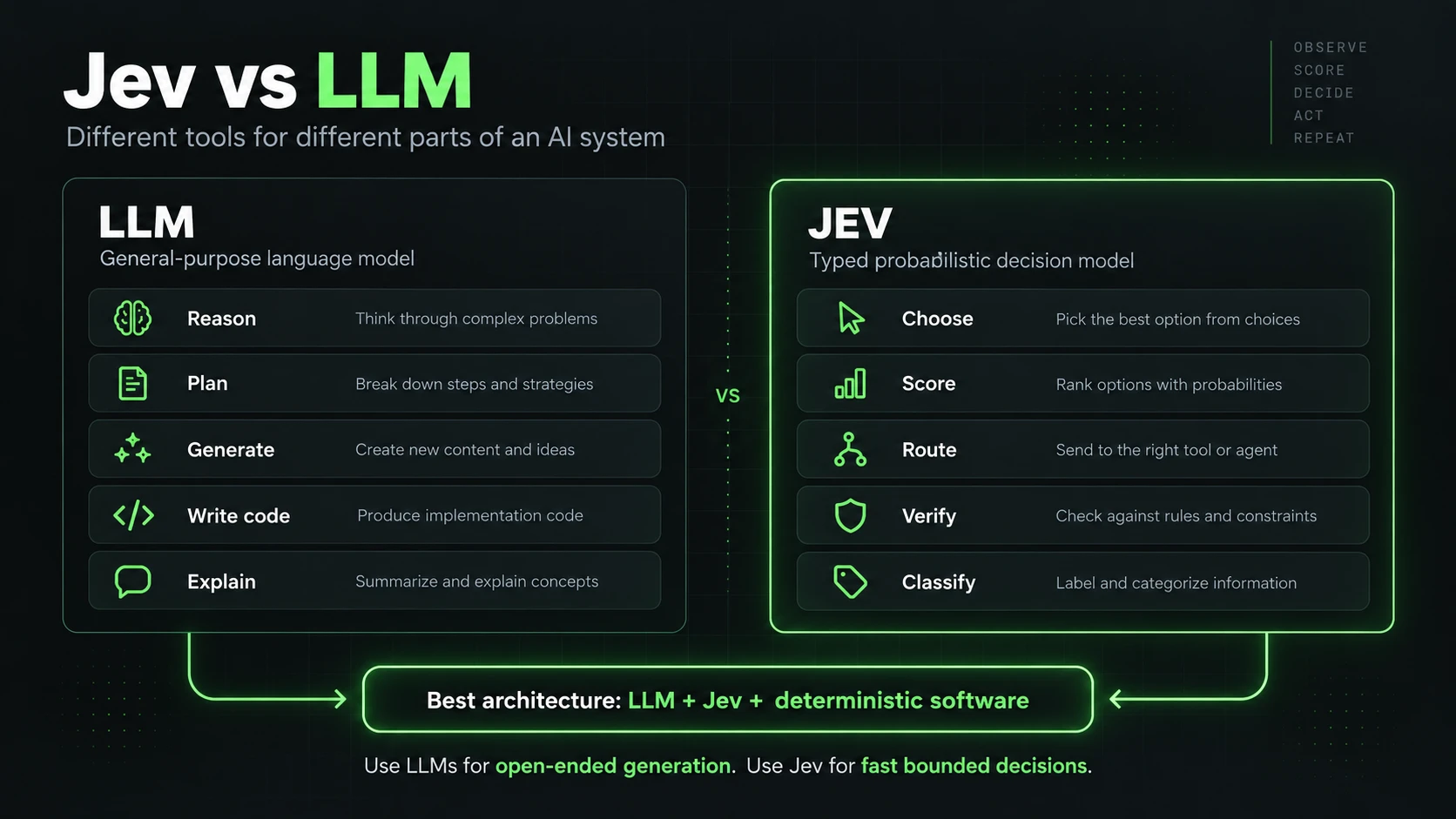
LLM“What should I do and how should I do it?”→reason / plan / generate
Jev“Which of these allowed actions should happen now?”→choose / score / verify
Jev vs LLM comparison for AI agents showing generation tasks versus bounded decision tasks
LLMs handle open-ended reasoning and generation; Jev is designed for bounded decisions such as choosing, scoring, routing, verifying, and classifying.

This does not mean Jev replaces an LLM everywhere. Many of the most interesting Jev agent architectures combine both.

  • The LLM: Handles open-ended intelligence & high-level synthesis.
  • Jev: Handles bounded, repeated decision points.
  • Code: Executes the result deterministically.

How Jev works: state in, typed decisions out

A Jev call starts with state.

That state might be: the current DOM of a browser, a coding task, a list of available MCP tools, an email, a pull request, a proposed agent action, or the current state of a workflow.

The developer also defines the decisions Jev is allowed to make.

For example:

STATE → TYPED DECISION
State: The user asked to find a flight to London.
Available actions:
- search
- click
- type
- go_back
- finish

Jev:
search   → 0.91
click    → 0.04
type     → 0.02
go_back  → 0.01
finish   → 0.02

The browser automation framework performs the action. Then the next state is sent back into the loop.

Jev decides. Code and tools act.

Where Jev fits inside an AI agent

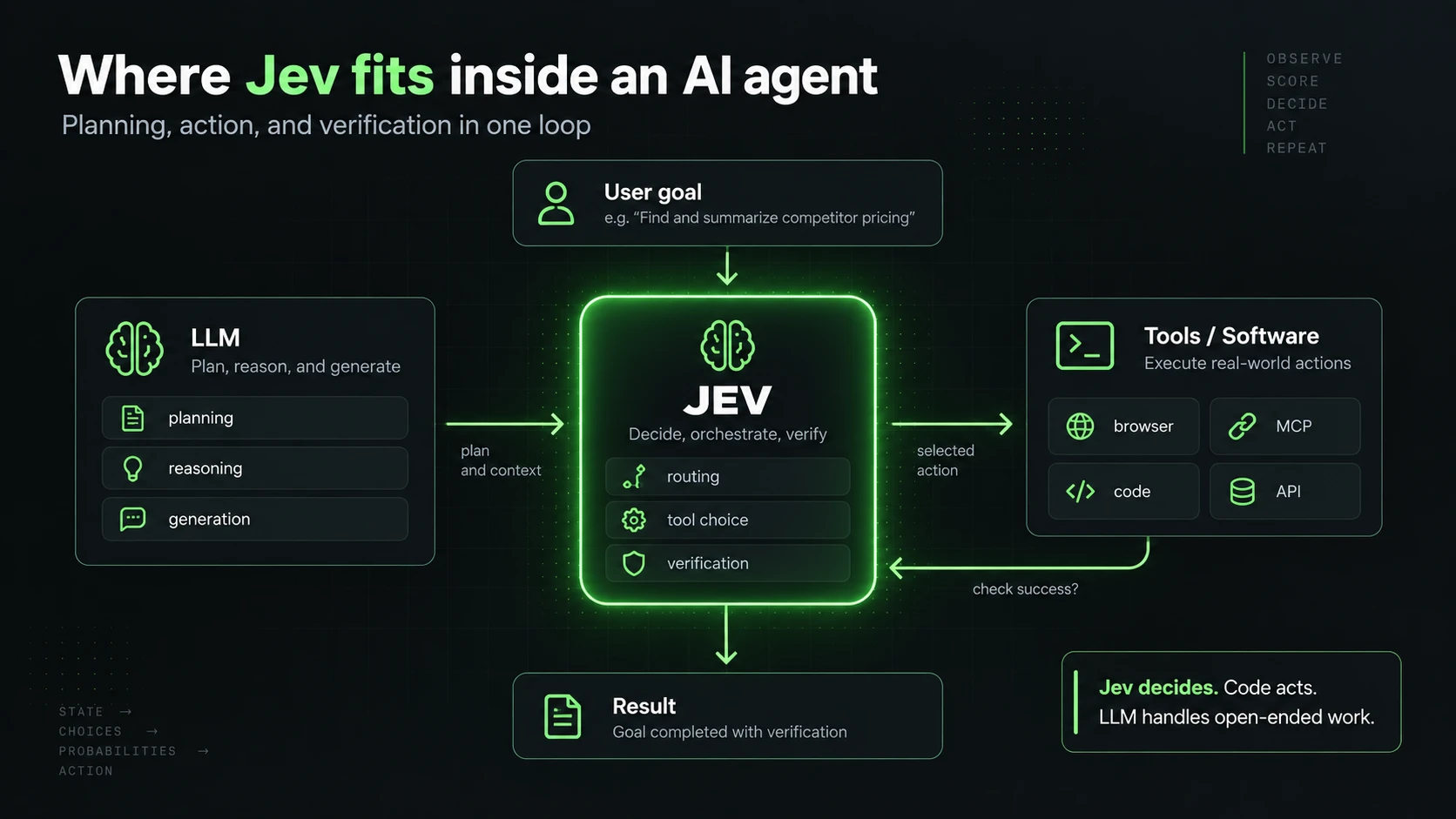
A common pattern in production systems: the LLM handles open-ended planning and synthesis, Jev handles repeated bounded decisions and verification, and deterministic software executes actions.

AI agent architecture showing an LLM for planning, Jev for decisions and verification, and tools for execution
A common pattern: the LLM handles open-ended work, Jev handles bounded decisions, and deterministic software executes actions.
SECTION 04 / THE COMPANY

What is TypeSafe AI?

Why TypeSafe built Jev

TypeSafe AI is the company behind Jev.

TypeSafe introduced Jev publicly on September 15, 2026 as its first System One Model. The company says it built a new model architecture, parallel sampling system and training approach called Reinforcement Learning for Calibrated Decisions (RLCD), with the goal of making AI intelligence easier to compose directly into software. (TypeSafe AI)

The idea is different from simply asking a chatbot to return JSON.

RLCD: Reinforcement Learning for Calibrated Decisions

With Jev, the possible output types are defined in advance, and the model returns probabilities that software can use when deciding whether to act automatically, retry, route elsewhere or ask for human review. TypeSafe describes this as “machine-native intelligence” designed for automation. (TypeSafe AI)

JevForAgents is independent from TypeSafe AI. We collect real implementations, demos, GitHub projects and developer reports to understand how Jev is actually being used inside agent systems.

SECTION 05 / AGENT PATTERNS

What can you use Jev for?

Jev is most useful where decisions are repeated, bounded, and machine-readable.

AI agents and browser agents

Browser agents frequently need to choose one action from a bounded action space: click, type, scroll, open a page, switch a tab or declare the task complete. Real projects combine Jev with Browser Use, Stagehand, and Cline.

Explore Browser Agents →

Model routing and tool selection

An agent does not always need its most expensive model. Jev can classify the current task and route it to a model, sub-agent, machine or workflow based on predefined choices.

Explore Agent Routing →

Evaluation, verification and guardrails

Agents need fast answers to questions: Did the task succeed? Is this PR safe to merge? Should this action require human approval? Does output satisfy policy? Is the agent stuck?

Explore Evaluation & Guardrails →

Coding agents, Codex and Claude Code

Developers are experimenting with Jev alongside Codex, Claude Code, Cline and MCP-based coding workflows for context filtering, code review, and next-action selection.

MCP and agent skills

Tool-heavy agents carry dozens of tool definitions. Jev evaluates current task state and selects the appropriate tool before invoking the main agent.

Explore Tool Selection →
SECTION 06 / DEVELOPER IMPLEMENTATION

How to use Jev

Jev API

Jev is available through TypeSafe's API. The current API exposes System One requests that can ask yes/no questions, select choices, evaluate scores and return structured results. (Typesafe API)

Jev with existing agents

A typical agent integration follows four steps:

  1. 1. Collect application state

    Gather the DOM, log output, user prompt, or active context.

  2. 2. Define the allowed decision

    Enumerate valid action choices, boolean checks, or scoring scales.

  3. 3. Send both to Jev

    Obtain deterministic typed results and calibrated probabilities in 70–250ms.

  4. 4. Let software act on the returned probabilities

    Execute tools, trigger fallback logic, route requests, or ask for human review.

POST /v1/systemoneTypeScript SDKPython SDK
84ms INFERENCE · ZERO HALLUCINATION
1. RAW STATE + BOUNDED QUESTION INJSON Payload
curl -X POST https://api.typesafe.ai/v1/systemone \
  -H "Authorization: Bearer $TYPESAFE_API_KEY" \
  -H "Content-Type: application/json" \
  -d '{
    "model": "jev-latest",
    "state": "DOM: <button id=\"book-ticket\">Book Now</button> | User: \"reserve 2 seats\"",
    "questions": {
      "next_action": {
        "type": "choice",
        "instructions": "Which browser action fulfills the user intent?",
        "options": ["CLICK_BOOK", "SCROLL_DOWN", "ASK_CLARIFICATION"]
      }
    }
  }'
2. CALIBRATED TYPE-SAFE PROBABILITIES OUTSub-100ms
{
  "answers": {
    "next_action": {
      "selected": "CLICK_BOOK",
      "probabilities": {
        "CLICK_BOOK": 0.942,
        "SCROLL_DOWN": 0.041,
        "ASK_CLARIFICATION": 0.017
      },
      "confidence": 0.942
    }
  },
  "latency_ms": 84,
  "type_error": false
}

The important design question is not simply:

“Can Jev do this?”

It is:

“Is this a repeated, bounded decision that does not require a full generative model?”

If yes, it is a strong candidate for experimentation.

SECTION 07 / ECONOMICS & PERFORMANCE

Jev pricing, speed and cost

TypeSafe structures Jev as a high-frequency micro-decision layer. Rather than billing for sequential token generation, input states are evaluated in parallel at ultra-low cost with zero output-token generation fees.

Input Tokens$42 / 1B
Output TokensFREE
Decision Latency70ms–500ms
Architectural Rule: Reserve frontier LLMs for top-level reasoning and synthesis, while delegating high-frequency loop steps (routing, tool selection, scoring, and policy guardrails) to Jev to cut overall inference cost.

Source: TypeSafe AI Launch Announcement. Metrics reported in community builds above remain author reports rather than independent guarantees.

🔒typesafe.ai/blog/introducing-system-one-models-and-jev
Official Source
TypeSafe AI official launch announcement comparing Frontier LLMs with System One (Jev): Input tokens $0.042/MTok, Output tokens FREE, 70ms-500ms response time
Official comparison table: LLM token generation vs. Jev calibrated decisions.
SECTION 08 / PARADIGM COMPARISON

Jev vs LLMs: when should you use each?

Jev and LLMs solve different parts of an AI system.

Better suited to an LLMBetter candidate for Jev
Open-ended writingClassification
Complex reasoningRouting
PlanningTool selection
Code generationScoring
ConversationVerification
Long-form synthesisGuardrail decisions
Novel problem solvingRepeated bounded choices

In many real agent systems the most useful architecture is not Jev vs LLM:

Jev + LLM + deterministic software.

Each component does the kind of work it is best suited for.

SECTION 09 / FREQUENTLY ASKED QUESTIONS

Frequently asked questions about Jev

What is Jev AI?+

Jev is TypeSafe AI's first public System One Model, designed to return fast, typed probabilistic decisions for use inside software and automation. (TypeSafe AI)

What is a System One Model?+

TypeSafe uses the term System One Model for a class of AI models optimized for rapid structured decisions rather than general-purpose string generation. (TypeSafe AI)

Is Jev an LLM?+

Jev is not designed like a conventional generative LLM. It returns predefined structured decisions and probabilities instead of freely generating text.

Who made Jev?+

Jev was developed by TypeSafe AI, founded by Diogo Almeida. TypeSafe publicly introduced Jev on September 15, 2026. (TypeSafe AI)

What is Jev used for?+

Current developer projects use Jev for browser action selection, agent routing, tool selection, classification, evaluation, verification, guardrails, coding-agent workflows and computer use.

Does Jev have an API?+

Yes. TypeSafe publishes an API for System One requests and model discovery. (Typesafe API)

How much does Jev cost?+

TypeSafe currently lists Jev at $42 per billion input tokens. Check the official TypeSafe site for the latest pricing before relying on it in production. (TypeSafe AI)

Can Jev work with Codex or Claude Code?+

Developers are already experimenting with Jev in Codex, Claude Code and MCP-based coding-agent workflows. JevForAgents tracks these projects separately so reported results can be distinguished from official TypeSafe claims.

JEV ARCHITECTURE GUIDE

Understand the decision layer before you add it to an agent.

Typed choices, scores, confidence, guardrails, and the evidence behind the current claims—all in one focused guide.

Read the builder’s guide →Explore Jev Assistant cases →